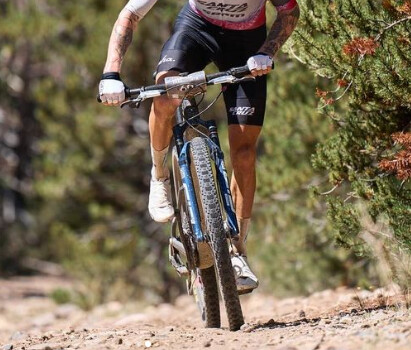
My hardtail is Shimano right now. My road/gravel bikes are SRAM.
The problem/cost is the frame and fork are both post-mount. All the new dropbar lever/caliper kits are flat-mount. Bare levers are available, but harder to find discounted and then you have to figure out which hoses/fittings to use. The Wolftooth PM-FM adapter is neat, but forces a +20mm rotor and I don’t want to run 180mm rotors on this bike. A.S.S. in Canada has adapters that don’t force the +20 - I need to measure the frame to see if they’ll work (they have much tighter tolerances).
AXS does make the conversion pretty easy - no cables, no pull ratio problems, etc. Even if I don’t go to drop bars, I’ll likely go to AXS (from Shimano 11 speed) later this season for ease of geared/SS conversion (I use the bike for SS racing at a local dirt crit series).
I really need to steak my neighbors custom Zukas monstercross for a week and see if I even like the style before committing any money to a conversion.
This is the article I used to build my Specialized Chisel into a Drop Bar bike. This thread kind of cracks me up with the amount of nerdery going to make hard tails into effectively gravel bikes. They aren’t. The Drop Bar MTB is an effective if you’re looking for long term comfort over long distances on challenging and changing terrain. It won’t be as aero as a gravel bike, and it most certainly will take more effort to get it up to speed, but the narrower form, and more ergonomic position than flat bars make it fast and comfortable. Two things that are paramount when spending all day, multiple days or weeks on a bike. Yes you have too look at specs and geo here for a bit but it comes down to just trying it. I’ve got thousands of miles clocked on mine on everything from black diamond Pisgah Gnar to flat and fast bike paths in Florida. It’s pretty well dialed.
the “exchange kit” option is a good way to get just the brifters (includes hose as well). then you can choose whatever calipers you want. (sram has a webpage which goes through different brake caliper hose compatibility).
Oh, hmm - maybe I got irritated by the big numbers of your given stem lengths compensations. In the end, if a rider shouldn’t end up like on a strechting bank, there is only so many centimeters a top tube can get longer while a “normal” stem is getting shorter. If we talk 11 cm stems (for S or M sized bikes and people) there’s basically only 7 cm the stem can get shorter and the top tube longer (if you are thought to sit somewhat similarily on said bikes).
(In this viewing we can omit flat vs drop by roughly compensating broader grip to narrower grip and added dropbar reach). But not 8-9 cm.
But yes - indeed. We seem to be on the same page now. Chalk it up to written communication and the state the recipients mind is at times 2 steps ahead.
Err, you mean me? Sorry - the TR form can be quite ambiguous in terms of seeing at a glance what post is meant to be a reply or follow up to which post before it. But maybe that’s just me.
If you mean my post I’m scratching my head why you’d connect top tube length as a parameter of, I assume, the theory I lay out in the steering article I referred to earlier. But rest assured - no, I’m not.
It’s just a number and like any other geometry number can inform you but has to be considered in relative dimension to all other geometry parameters. And even then it’s only a first (sound) guestimation how a bike really rides and feels. But the proof is always in the pudding, i.e. actual riding.
But actually I often get asked about top tube lengths and from people worrying about either having to shorten the stem of a flatbar bike dramatically to put on a drop bar (because of reach) and nearly equally as often worrying about having the lengthen the stem to somehow counter the feared massive amplified “Twitchiness”. Neither is the case and why that is and how you can arrive at a good starting place stem length wise is precisely the reason I wrote that article (and draw schematics) in the first place.
The geometry is messed up for the Epic, it’s bottom bracket height is calculated incorrectly probably due to how the bike had to be input in order to display the diagram. BB Height should be around 310-320mm.
For a general comparison like this, it’s also worth fixing the tire size on the Epic WC, and use the “align ground” setting in the top right corner… It helps you visualize the stance of both. These two are worlds apart… I wish they weren’t, but they are. As mentioned earlier, I wanted to justify a similar build, but its just so niche, and might be compromising on too many fronts. Headlines: a full 100mm longer front center is going to tough to overcome, weight distribution wise. This doesn’t even account for the fact you’ll be a full 60mm higher in the front end, exacerbating the problem of getting some weight over the front tire. With the 40mm-60mm stem you’ll be running combined with the 4d slacker heat tube angle, turning is just not going to be confidence inspiring with drop bars. The trail numbers are pretty far apart, and it would feel pretty wonky at low speeds.
The epic wc is going to have the front wheel much further out, and that will take a lot of attention to make it turn well. You will need to weight the front end harder. I find I have issues with this kind of thing, because with longer front ends I’m fairly prone to making drop bars slip and rotate down.
If you don’t get enough weight on the front it will feel wayward and prone to understeer
Thanks. I’m getting discouraged by the complexity of this conversion. OTOH Dylan Johnson seems to have gone pass through all this and appears to have no issues with handling.
Try running the numbers for his Factor Lando HT and see where it comes out. And, then compare to a handful of different gravel bikes. Throw in some like the Stigmata and Fezzari Shafer that are known to be a little slacker.
I think we’re going to see more Gravel Bikes that can comfortably take 2.2+, so I’m not sure I’d be in a rush to start making a conversion like this unless I was real sure about it.
I wonder about this as well, I think there’s not enough people with enough experience to really understand the dynamic as applied to other bikes and riders.
Part of what I suspect makes it work well for DJ is his setback is so small (might be negative) the front center and overall wheelbase have less power on the handling otherwise. This is with a 75.5° STA:
My drop bar MTBs are older XC geometry (74-76° STA and 70-71° HTA high 80s trail) but even then I needed 50-52cm handlebars to get the front end where it felt good on descents and rough tracks. I’m not sure how he’s descending so well on ~38cm handlebars with 695mm front center and 100mm trail.
On the other hand, my normal gravel bikes are 605-610 front center with low 70s trail and I built an old hybrid conversion to drop bars that ended up with 675 front center and high 60s trail and it handles great.
So I guess don’t get discouraged. This sounds like spurious advice but maybe ask and see if anyone local has a similar bike you can try. A few years ago (before covid) someone asked on our local gravel FB group about drop bar MTBs, trail, etc., I commented and we met up so he could ride loops on the MTB trails on my bike. I’ve done the same with my low-trail rando bike. Something to think about.
It’s probably worth stating, that all of this is pretty insignificant in the big picture. We’re not converting tandems to unicycles… Bikes in general put us, the rider, in a pretty wacky position. It only takes time for this to feel normal… So despite it looking so massive on paper, in context, these changes aren’t going to feel absurd. I frequently ride my 760mm wide flat bars the day after riding my road bike and it takes about two minutes before you re-adapt to a different feel and your brain is pretty good at compensating for the rest of the inputs and outputs…
I want to see a drop bar Epic WC, and despite my frivolous spending on bikesI couldn’t justify it, but I fully support someone doing it!
Just occurred to me that it would probably be worthwhile to look at the Chamois Hagar as it has a pretty comprehensive review from James Huang and is closer to the Epic to give some idea of progressive geo + drop bars.
And while that unique front-end geometry works great at higher speeds, it doesn’t work as well at slower ones. There’s a ton of wheel flop, and it’s harder to hold your line than it should be, especially on technical climbs where you really need to be careful in placing your wheel. In particularly tight corners, too, the Chamois Hagar tends to understeer.
“At lower speeds, such as going up a meandering gravel climb, the bike almost feels like it’s had too much to drink and is stumbling home,” Dave said.
This is close to my experience trying to manage 655 FC with ~80mm trail/45mm stem/44cm handlebars - took a lot of muscle to get the bike into a corner but then the fine control was so degraded that it was difficult to manage the bike’s road surface feedback and attitude in and out of the corner. Moving to 52cm handlebars was a big improvement and I would assume the trend would hold to even wider but then you’re always suffering both aero losses and the idea that “wait why am I on 60cm+ drop bars and not just flat bars?”.
So it’s a hard balance. I rode quite a bit on 38cm drops on my allroad bike and could never manage very well offroad. The aero gains are obviously there but it’s possible to lose enough time on descents and rough stuff to outweigh those gains, course dependent.
I originally went for dropbar MTB to get more tire clearance, hand positions for long races, and because I find dropbars a lot of fun offroad. My MO is as much having fun as it is race performance, or else I’d probably just be looking at race gravel and flat bar XC MTB.
Correct me if I am wrong, but there was a reason why he built the special bike: he broke his arms and after that the riding was too painful on his normal gravel bike.
That seems overly cynical, considering he raced the Badlands 2023 on the bike.
The build looks good to me, ~45mm stem and ~52cm handlebars. Certainly better than a lot of conversions I’ve seen. At least we’ve mostly moved out the of LD stem/dirt drops paradigm from last decade.
Even without a dropper a (good) dropbar MTB is going to perform much closer to an MTB than a gravel bike is going to be to the dropbar MTB. The capability of the front fork (and wider tires) is worth a lot, even accounting for any compromises to pair with drop bars.