Well you could go tubeless. Everybody who rides road tubeless assures me that it makes them way, way, WAY faster. And that it’s absolutely no trouble at all!
Let us know how it goes for you.
Well you could go tubeless. Everybody who rides road tubeless assures me that it makes them way, way, WAY faster. And that it’s absolutely no trouble at all!
Let us know how it goes for you.
Whilst pinch flats are more likely at lower pressure, your regular puncture is actually more likely at a higher pressure, as the tyre has less ability to deform around debris, making it more likely to punch through
When I was commuting regularly a few years ago before I got a fulltime WFH job, I was experimenting with lower and lower pressures. At one point I was running 30psi in 32mm road tyres with tubes! I definitely got less punctures as I dropped pressures
First I’ve come to count on the 60/40 back to front weight dispersement rule.
From experience and manufacturers recommendation I work my way backwards depending on my weight.
I’ve never seen a tried and true chart or equation that made it any easier to dial in tire pressure specific to my bike and weight?
I run 60F/65R on the roadie on 28C tyres and approx 1.4 and 1.6 Bar on the MTB 2.3" tyres.
I came to these pressure by someone telling me to try it and it feeling “fine”. 

I pump them up every so often to around 80-90 psi (they’re tubeless) and leave them until the push test says they are too soft. The can fall below 30psi before they lose any perceived performance.
When I’ve run tubes its similar but higher, I pump them up to 90-110psi and 60psi is when they perceivably lose performance.
Oh and they’re road bike tyres and usually 25mm.
If you looks at the spec (and assume your pump gauge is @ spec!), your typical floor pump has 2% accuracy from 40psi to 120psi. Most floor pumps are 160psi full scale.
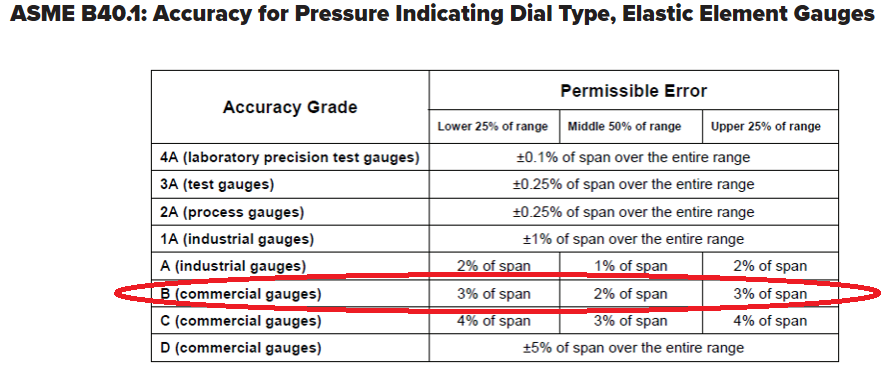
There is a different spec for digital gauges & I’d say there is no real bike pump ‘standard’ for that type of device. So check w/ the manufacturer.
Who cares? Nobody, probably! But I’ll be able to find this chart no prob later on so thanks for the storage TR forum!
I should have used more words!
60/40 is a percentage of weight distribution of a body on a bike!
So depending on the tire per say i would put 100# in the rear and 80# in the front. As a amateur cyclist i don’t care that these weights and figures are correct to the digit, however current science shows if you’re pumping both front and rear to the same pressure you’d be getting less than equal rolling resistance! Also handling will be compromised accordingly!
about 3psi more than what felt like I was gonna bottom the rim out on. For me that works out to 34F/36R on my 700x40 Maxxis Ramblers on my HED Eroica’s
I’ve been using Hed’s recommended pressures for the road for years with great results.
I found some 2-month old pavement on a 1.1 mile traffic free loop & just took the data. 23mm conti’s on 404 firecrests. Sure enough, rolling resistance bottomed out at around 95psi. 70psi was about the same as 120psi from a rolling resistance perspective.
Got my eye on a chipseal loop. Wonder if tire pressure can go low enough on that surface to see the turnaround.
how did you test rolling resistance?
Chung Virtual Elevation on some rides with steadily increasing speed from start to finish.
I assume you just try to maintain your position and use a static CdA number in the analysis then vary Crr to match?
Sort of. The trick is that Crr is comparatively more of the total ‘drag’ when your going slow vs when your going fast. So do a run where you’re constantly increasing speed in a controlled fashion. That makes the selection of proper Crr a little more obvious.
But know this: I’m not the correct person to be giving advice about proper methodology in these sorts of things. I’ve been saying that a lot over the past couple weeks! I got help/advice from some of the best at this sort of thing & don’t mean to mis-represent myself as an expert on any part of it.
I know how to do a basic CdA in there using a rough approximate Crr, but thats about it  so long as im testing changes back to back and with the PM offset updated before each interval it seems to work well enough
If you want to take a crack at Crr, pick a flat course.
Lately I’ve been using Bicycle Quarterly
https://www.renehersecycles.com/finding-the-perfect-tire-pressure/